Although this pamphlet is mainly concerned with working class politics and club life in Hackney from the 1870s to the end of that century, previous developments cannot be ignored. Political movements and forms of organisation do not arrive completely by surprise, nor spring from the earth unseeded. Although different periods are marked by a different intensity of political change, some seeming much more dynamic than others, there is always some thread of continuity. Ideas are passed on from one generation to another; memory retains the power to re-establish the political tradition at the most appropriate time.
So in the 1860s there were two important developments in radical politics nationally which had an important effect on the political culture of Hackney. The first was the revival of a national Reform movement to argue for the extension of adult suffrage. 1866 saw a year of large scale political activity in support of a new Reform Bill. There were large demonstrations in many towns and cities, in which trade unions played a prominent part, and in the summer of 1866 a demonstration to Hyde Park, on finding the Park gates locked on arrival, pushed down the railings and stormed the Park. Hackney workers were very active in this movement, and there were, in fact, seven different branches of the Reform League active in Hackney in 1867. A list of the branches, their meeting-places, and the names of the officers is included as an appendix at the end. In 1867, the year after the Hyde Park demonstration, the great majority of urban working men received the vote.
The other development was the formation in September 1864 of the International Working Men's Association, also known as the First International. This was set up by a number of English trade unionists and working class politicians, and Karl Marx was one of its leading lights. Its object was to link the efforts of trade unionists in many different countries. Again, quite a few Hackney workers were involved in setting up the I.W.M.A., and one of them, John Hales, was one of its first secretaries. Hales became a very important figure in working class politics in Hackney in this period. He was also active in the Reform League in Hoxton and Shoreditch, was secretary of the Hackney Road branch of the First International in 1872, was a founder member of the Borough of Hackney Working Men's Club, and later of the Commonwealth Club in Bethnal Green Road. It was people like Hales who effected this continuity between different political periods, as can be seen in the following appreciation written by a socialist of another era, George Lansbury, in his autobiography published in 1928:
My advisor and friend was John Hales who, during the days of the Commune (1871), was secretary of the First International, established by Marx and his friends in 1864. Hales told me about the International and taught me the need of working class solidarity. The fact is that although men like Hales and early working class radicals like Howell, Lucraft, Applegarth and Odger failed to follow Marx and establish a socialist organisation, they did see further than most of those with whom they came in contact.
There were five separate sections of the First International in Hackney in 1872/3, further details of which are supplied at the end. (Appendix 2) The first secretary of the I.W.M.A. was W. Randal Cremer, one of the leaders of the Amalgamated Society of Carpenters and Joiners, who was later to become a Radical Liberal M.P. for Haggerston. The primary school in Shoreditch is named after him.
John Hales was also active at the end of the 1860s in forming the Land and Labour League, which became a forum and clearing house for what can be called the 'proletarian left'. This organisation published The Republican as its semi-official journal, and this was edited by George Standring, a Hackney secularist. The Land and Labour League in turn helped bring about the formation of the Labour Protection League in 1871, which tried to organise the dockers, engineers, labourers, dustmen, slopmen and scavengers. There is a record of them organising a meeting of some 20,000 in Shoreditch in July 1872.
Another strand of unorthodox and oppositional opinion of this time found form and focus in secularist propaganda. In many ways it was very important to dispute firstly religious dogmas of the time before any ground could be made for more radical political ideas. For in this period the commonplaces of a hymn like All Things Bright and Beautiful—'The rich man in his castle / The poor man at his gate / He made them high or lowly / He ordered their estate'—were often felt to be eternal truths. Free thought was a pre-condition of political independence.
So in 1873, when the Reverend C.M. Davies was preparing his collection of essays on secularist and eccentric religious and political movements and sects in London for his book Heterodox London, published in 1874, he devoted a complete chapter to "Hackney Propagandism." In this essay he describes how, after some problems of transport to Hackney from the centre of London, he found himself 'in due season at Heterodox Hackney - the most heretical, as far as my present experience goes, of the various quarters of the metropolis'.
What he found in Hackney in 1873, given that these meetings were, it seems, housed in their own premises, and the speakers and listeners probably well known to each other, suggests that secularist activity had been going on at least from the 1860s—and was in fact established in the borough. On that wet, March Sunday evening in 1873, he says:
No less than three 'regular' gatherings conspired to seduce me from the paths of orthodoxy on a single Sunday evening. The United Secularists' Propagandist Society, and the Hackney Secular Association were to meet at Perseverance Hall, Goldsmith's Row, Hackney Road; and Mr. Cox was to enlighten the latter body on the subject of "The Heroes of the Bible", while at the Minerva Club, Triangle, Hackney, Mr. Hyde was to devote his energies to a solution of the problem, "Would Professor Fawcett be a suitable Representative for Hackney?"
The audience for Mr. Cox's lecture at the Hackney Secular Association consisted of about thirty men and one woman. Davies described them as generally of a 'lower order' than those usually found at Secular meetings, with 'tidy working men' in a minority amongst a generally unwashed audience who had apparently so recognised the 'close connexion of cleanliness with godliness ... that they abjured the former with the latter'.
An informal discussion in progress when Davies arrived concerned the desirability of merging the two secular societies meeting at Perseverance Hall into one, but it was decided that both ought to retain their individual identity whilst continuing to work fraternally. Davies described the lecture at length, a passionate attack on the veracity of the stories and miracles described in the Bible. The rhetoric was not simply anti-religious, but egalitarian in sympathies:
He (Mr. Cox) traced the growth of the peoples clearly enough through the time of tillage and pastoral pursuits, with patriarchal customs, till a time when they came to have judges; and then, 'worst of all, kings'. (A remark which brought the house down.)
And towards the end, the lecturer provides us with some indication of the changing political atmosphere of the period, in which it seems to be becoming easier to attack, in quite outspoken language, established religious and political conventions and assumptions:
This book, observed the lecturer in conclusion, had done more harm than any other that had ever existed. Why was it bolstered up by priests and tyrants? Why did George the Third want to put the Bible into every child's hands? Because it supported the aggrandisement of the priesthood. For the same reason now it was sought to force the Bible down the throat of every child in school. There was fair hope, however, that this would not be so. Secularism was spreading. When he was a young man it would not have been safe for him to stand up and speak as he had spoken that evening.
Stirring stuff, even as we read it today. The reference to the compulsory religious education of school-children clearly refers to the advent of schooling for all which had been made law three years previously, with the 1870 Forster Act. The meeting at the Minerva Club, to which Davies had sent a friend to deputise for him, was a much smaller affair, and consisted of 'eight seated round a table meekly listening to a free and independent Hackney elector who was spouting on the merits of Professor Fawcett'.
II
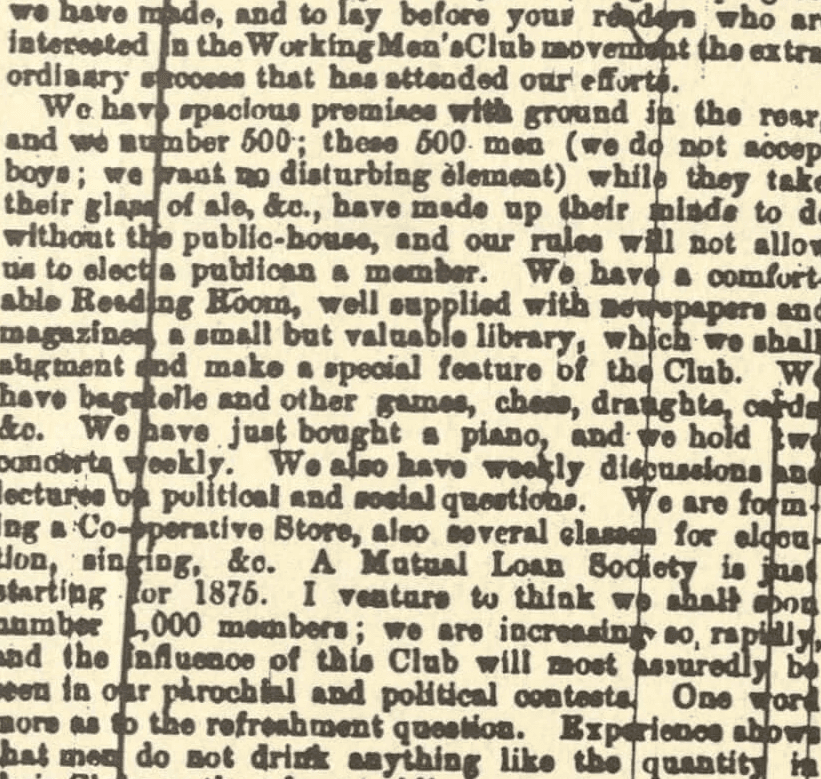
The first working men's club in Hackney was the Borough of Hackney Club, which was opened in November 1873, and which played a pioneering role in the national development of working men's clubs in that decade. One of the most important things about the Borough of Hackney Club is the spirit of independence in which it was set up by men 'without seeking any aid from any class of society outside their own'. The membership consisted of tailors, shoemakers, mechanics and other tradesmen, and many men 'of a humbler position than that of skilled artisans'. In a letter to the Hackney Gazette, published on 6 January 1875, the President of the Club, James Lowe, wrote outlining the aims and activities of the Club, established at 27 Haggerston Road:
We have spacious premises, with ground in the rear, and we number 500; these 500 men (we do not accept boys; we want no disturbing element) while they take their glass of ale, etc., have made up their minds to do without the public house, and our rules will not allow us to elect a publican a member. We have a comfortable Reading Room, well supplied with newspapers and magazines, a small but valuable library, which we shall augment and make a special feature of the Club.
We have bagatelle and other games, chess, draughts, cards, etc. We have just bought a piano, and we hold two concerts weekly. We also have weekly discussions and lectures on political and social questions. We are forming a Co-operative Store, also several classes for elocution, singing, etc. A Mutual Loan Society is just starting for 1875. I venture to think we shall soon number 1,000 members, we are increasing so rapidly, and the influence of this club will most assuredly be seen in our parochial and political contests.
One word more as to the refreshment question. Experience shows that men do not drink anything like the quantity in their Clubs as they do at public houses (our temperance friends should foster the Club movement), and as there are large profits, we are enabled with our subscriptions (6d monthly) to pay our way without asking for outside aid. We want no charity, and we shall live down the falsehoods spread about us, for the excellent management, the harmony and good feeling, existing throughout the institution have won the approbation of nearly everyone of the large number of strangers who have visited us.
Lowe's letter to the Gazette, quoted in full, gives some idea of the comprehensiveness of this extraordinary political and cultural project. The people who founded it were ambitious. They did not want to create a small, exclusive institution. "Numbers unlimited!", a political slogan from the Chartist years, was clearly their ambition. The range of facilities they offered was wide, and whilst they were not afraid to hope to claim a political impact in Hackney as a result of the Club, they were not so narrow that they thought singing and games might divert men from a single-minded preoccupation with politics.
The plans for the Co-operative Store and the Mutual Loan Society are also important expressions of the self-managing ideology of the working class politics of the period. The Club, in short, tried for men at least to promote a new kind of model for political and cultural development based on mutuality, co-operation and self-definition.
The elocution class which was mentioned by Lowe in his letter to the Hackney and Kingsland Gazette in fact turned out to be much more used as a workshop for amateur dramatics. John Taylor claims that, in this detail as well, the Borough of Hackney Club pioneered the association between working men's clubs and the tradition of the theatre and music hall. One of the founder members of the Borough elocution class was a certain Sam Clayton, who already had a name in metropolitan club life for his interest in the theatre. With his help the class gave their first public performance in aid of the Club's Library Fund in August 1875, in a one-act farce called A Thumping Legacy. From then on the Club's own theatre company became a standard feature of club life in Hackney and beyond.
The Club's interest in politics went far beyond the 'parochial contests' mentioned by Lowe in his public letter, although it is important to realise that the politics of these clubs was not socialist. It was a little while before socialism came on the agenda and when it did it was not necessarily endorsed by the clubs. The basic position of a club like the Borough of Hackney was on the extreme left of the Liberal Party, with the themes of Republicanism and Atheism to the fore. The clubs of Hackney and of East London as a whole were part of the catalyst that helped bring about the socialist and labour movement of today.
The Borough of Hackney Club took part in all the major battles of the day, and was ready to co-operate with other clubs and workers' organisations in many activities. In 1876 the Club was the springboard for agitation against the Tory government's proposal to support Turkey in the war against the Bulgarians. A crowded public meeting was held at the Club to protest against the action of the government 'with regard to the atrocious barbarities of the Turks in Bulgaria', and several resolutions were carried with acclamation. The meeting helped bring about the formation of the Eastern Question Association whose treasurer, William Morris, was later to play an unparalleled role in the revival of socialism in the 1880s.
One of the most striking features of the clubmen on the march was the sight of the massive banners and brass bands. These impressive sights were not only used in political demonstrations but were also used as general publicity. A journal of 1877 describes the sight when the Borough of Hackney Club visited the Walthamstow Club during February of that year. The clubmen marched into Walthamstow with their brass bands and gigantic banners flying, on which were:
...inscriptions expressing the advanced political opinions known to distinguish the men of Hackney. It was a sight to see the 350 members gallantly plunging through the mud and mire everywhere prevalent at this season but nowhere so prominent as in the road near Markhouse Common.
These advanced opinions displayed on the banners have thankfully been recorded for us although the banners themselves have long disappeared to oblivion. The Hackney Radical Club had a massive banner that included amongst its various designs the slogan 'That there should be classes that exclusively enjoy the fruits of other people's labour is opposed to reason and justice'. The United Radical Club banner displayed 'a figure of Liberty trampling upon the prostrate form of Despotism, with his shattered shackles and minions, Priestcraft and Privilege'.
The other clubs appearing in Hackney in this period were the United Radical Club, the Kingsland Progressive, the Commonwealth Club, the Hackney Radical Club, and the Clifden. The Commonwealth Club at 246 Bethnal Green Road was started as a breakaway from the Borough of Hackney Club by John Hales and others in 1876. Hales represented the club at the Ghent Socialist Congress in 1877. It is almost impossible to date the beginnings of the other clubs as they are given different dates in different sources.
By the early 1880s the Clifden Club was established at 13 Goldsmith's Row (taking over the Perseverance Hall mentioned in Heterodox Hackney?). At some point in that same decade the Hackney Radical Club was established in Kenmure Road, where it enjoyed a long life, serving as the Strike Headquarters of the Hackney Trades Council in 1926. The United Radical Club was originally a breakaway from the Clifden Club in 1883. One of its members later recalled:
We well recollect their starting in the Hackney Road, in an upstairs, ill-ventilated room, with rough deal forms and tables, and its 18 members working hard to make the place as comfortable as possible for members of other clubs who might wish to call.
By 1889 the United Radical Club had established new premises in Kay Street, Hackney Road, and was the biggest in East London with 2,000 members. Of the Kingsland Progressive Club, established at 277 Kingsland Road, we know rather more, thanks to a brief description by Frederick Rogers in his important East London autobiography, Labour, Life and Literature. He speaks well of the founder of the new club, a 'workman of striking personality, Charles Baines', and suggests the club was certainly going by 1878. However, it lacked the ambitiousness of aims of the Borough Club, and, as Rogers so succinctly puts it:
The Progressive Club, however, did not progress. It had none of the spontaneous life and go that marked its neighbour, the Borough of Hackney. It cultivated dancing among its members, and its balls were well attended. Sometimes a political meeting was followed by a ball, and, as a club was a private house in the eye of the law, they could keep their dancing up to as late an hour as they liked. I often went to the Progressive Balls and enjoyed their hearty, honest amusement, though the dancing was often of a rough-and-tumble kind.
In 1884 James Lowe—a founder member and first President of the Borough of Hackney Club—died. Rogers describes the funeral as 'one of the sights of East London ... with endless crowds of people who turned out and lined the streets to see the body pass to its last resting place'. Rogers mentions in his autobiography an interesting custom which followed on from Lowe's death whereby Club members wore violets in their lapels on the anniversary of his death, which became known as Violet Day.
There is an interesting account in Labour, Life and Literature, in which Rogers recalls one of the lectures he attended at the Borough of Hackney Club, a lecture on "Physiology in Everyday Life", and the lecturer is described as having 'to the full the popular gift of putting his statements in clear and simple language'. The lecture was also full of 'sly drives at the clergy, chiefly those of the Church of England, which were highly appreciated by the audience'.
One Hackney clubman who is mentioned in several accounts of London club life was Richard Gaston. Rogers describes him as 'a workman with strongly marked characteristics and many abilities, a club actor and reciter; and, as editor of the Club and Institute Journal, he was perhaps the first club journalist'. A poem of his expressing the independent sentiments of the working men's club movement was first read at the United Radical Club on 20 May 1885; an acute sense of class-consciousness is paramount:
We working men are often called hard names by jealous scribes,
And made the butt of many jokes, and sneers and cruel jibes;
We are the 'mob', the 'great unwashed', sometimes the 'dregs' and 'scum';
As if they thought from working men no good could ever come.
But if we drink we also think; we're not all thoughtless men;
We have as much (perhaps more) good sense as have the Upper Ten;
And if some proof they wish to have that my remarks are true,
Let them come here and see this club, that has been built by you.
We've asked no guineas from the rich, nor patronage from peers;
We're independent of them all, and have been so for years.
To build their churches and their schools the parson often begs;
The 'scum' pay for their clubs themselves, as also do the 'dregs'.
We have toil'd hard, been oft cast down, depressed, yet not lost heart;
We felt success would crown the end, though humble was the start.
So now tonight we welcome friends from clubs both far and near,
To share the pleasure that we feel in what we're doing here.